guides
Mindfulness for Kids: Simple Ways to Start at Home

Simple, screen-free mindfulness for kids you can start at home today: quick breathing games, a five senses trick and calm bedtime ideas by age.
Your child is wound up after school, or wired at bedtime, and you have tried everything to help them settle. You have heard mindfulness might help, but you are not sure where to begin, or whether a small child can really do it.
Good news: you do not need an app, a course, or any kit. You can start today with a couple of quiet minutes and your own calm voice.
Here is how to make it simple, playful and genuinely useful at home.
What is mindfulness for kids, in plain terms?
Mindfulness for kids just means helping your child notice what is happening right now, in their body and around them, instead of getting tangled in worried thoughts. Anna Freud, a leading UK children's mental health charity, describes it as a way to enjoy life more and pay better attention to the world around us.
For children, that usually looks like noticing their breath, their senses, or the feeling of their body on the floor. It is not about emptying the mind or sitting in silence for ages.
Think of it as a calm, screen-free habit rather than anything clinical. It can help a child spot and settle big feelings, wind down before sleep, and focus, but it is not a cure for anxiety or a replacement for professional support.
How do you actually start mindfulness at home?
Start with one short, playful technique at a consistent time, like after school or before bed, and do it together. Keep it to three to five minutes, use no special kit, and treat it as a shared calm moment rather than a lesson your child has to get right.
Doing it alongside your child matters. You are modelling calm, not marking homework.
Here are five ways in. Pick one and try it for a few days before adding another.
1. Balloon (belly) breathing
Ask your child to put a hand on their tummy and imagine slowly blowing up a balloon inside it as they breathe in, then letting it deflate as they breathe out. Anna Freud suggests short guided breathing like this as an easy first step. If it feels a bit fiddly at first, that is completely normal, so keep it light and unhurried.
Aim for a longer out-breath than in-breath, which helps the body settle.
2. Square breathing
For school-age children, try square breathing: breathe in for four seconds, hold for four, breathe out for four, hold for four. Anna Freud teaches this as a simple way to calm the body when feeling anxious. Trace a square in the air with a finger as you count.
3. The five senses game
A brilliant grounding game for a busy mind. Ask your child to name five things they can see, four they can hear, three they can touch, two they can smell, and one they can taste. It pulls attention gently back to the present.
4. Mindful colouring or a craft
Slow, quiet colouring counts. Encourage your child to notice the colours, the sound of the pencil, and how their hand moves. There is no finished picture to judge, just the doing.
5. A bedtime body-scan
Lying down, ask your child to notice each part of their body in turn, from toes to head, letting each bit go soft and heavy. It pairs beautifully with the wind-down before sleep, and a soft floor space or mat makes it comfier.
For more on the breathing side, our guide to breathing exercises for kids has extra ideas you can rotate through.
What if my child cannot sit still?
If your child cannot sit still, do not fight it. Make mindfulness move. Swap silent sitting for gentle movement like kids' yoga animal poses, slow stretches, or mindful walking where they notice each footstep. Movement gives a restless body something to do while the mind still settles.
This is where yoga and mindfulness meet so neatly. YoungMinds notes that regular gentle movement, which does not have to be strenuous, helps reduce the physical feelings of anxiety in children, and that walking or gentle yoga can help.
Doing an animal pose while breathing slowly is mindfulness in disguise, and far easier for a wriggly three-year-old than sitting cross-legged in silence. Our overview of the benefits of yoga for children explains why this works so well for younger ages.
What age can children start, and how do I adapt it?
Children can start from toddler age, as long as you match the activity to the age. Toddlers and pre-schoolers do best with sensory games and playful animal poses. School-age children can manage short breathing exercises and a brief body-scan. Keep every session short and led by their attention span, not the clock.
Little and often beats one long session. A two-minute wind-down at bedtime, most nights, does more than a rare twenty-minute effort.
- 3 to 5 - Try this: Balloon breathing, animal yoga poses, five senses game; Roughly how long: 2 to 3 minutes
- 5 to 8 - Try this: Square breathing, mindful colouring, short body-scan; Roughly how long: 3 to 5 minutes
- Any age - Try this: Mindful walking, doing it together at a set time; Roughly how long: A few minutes daily
Why is a calm, screen-free routine worth it?
A short screen-free calm routine protects the things that matter most for a child's wellbeing: sleep, movement and family time. UK government guidance for parents of under-fives notes that too much solo screen time can crowd out the things that make the biggest difference, namely sleep, play, physical activity and time talking with parents and carers, so building in quiet, screen-free moments is a sensible balance.
The Sleep Charity points out that good sleep helps children learn, remember and manage their behaviour, and the same government guidance advises no screens in the hour before bed to protect sleep. A calm breathing routine is a lovely swap for a screen in that last half hour.
It also fits the wider picture. The NHS recommends children aged 5 to 18 get at least 60 minutes of activity a day, and the World Health Organization stresses daily active, screen-free time for under-fives. Gentle mindful movement quietly adds to that.
If your child is really struggling with worry or low mood, mindfulness is a helpful habit but not a treatment. Please speak to your GP, and organisations like YoungMinds and Anna Freud offer trusted parent guidance.
Frequently asked questions
How long should a mindfulness session be for a young child?
Keep it short. Two to three minutes is plenty for a toddler or pre-schooler, and three to five minutes suits most school-age children. Doing a little most days works far better than one long session now and then.
Does mindfulness actually work for children?
It can genuinely help children notice and calm big feelings, settle before sleep and focus. UK charities including Anna Freud and YoungMinds recommend mindfulness and gentle movement for wellbeing. It is a supportive habit, though, not a cure for anxiety or a substitute for professional help.
What is the easiest technique to start with?
Balloon breathing is the gentlest entry point. Your child puts a hand on their tummy and slowly breathes the imaginary balloon up and down, with a longer out-breath. It needs no kit and works almost anywhere, including in the car or at bedtime.
Do I need to buy anything to start?
No. Mindfulness needs nothing but a quiet couple of minutes. A soft mat or clear floor space just makes poses and a bedtime body-scan comfier, but you can begin tonight with what you already have.
Give calm a soft place to land
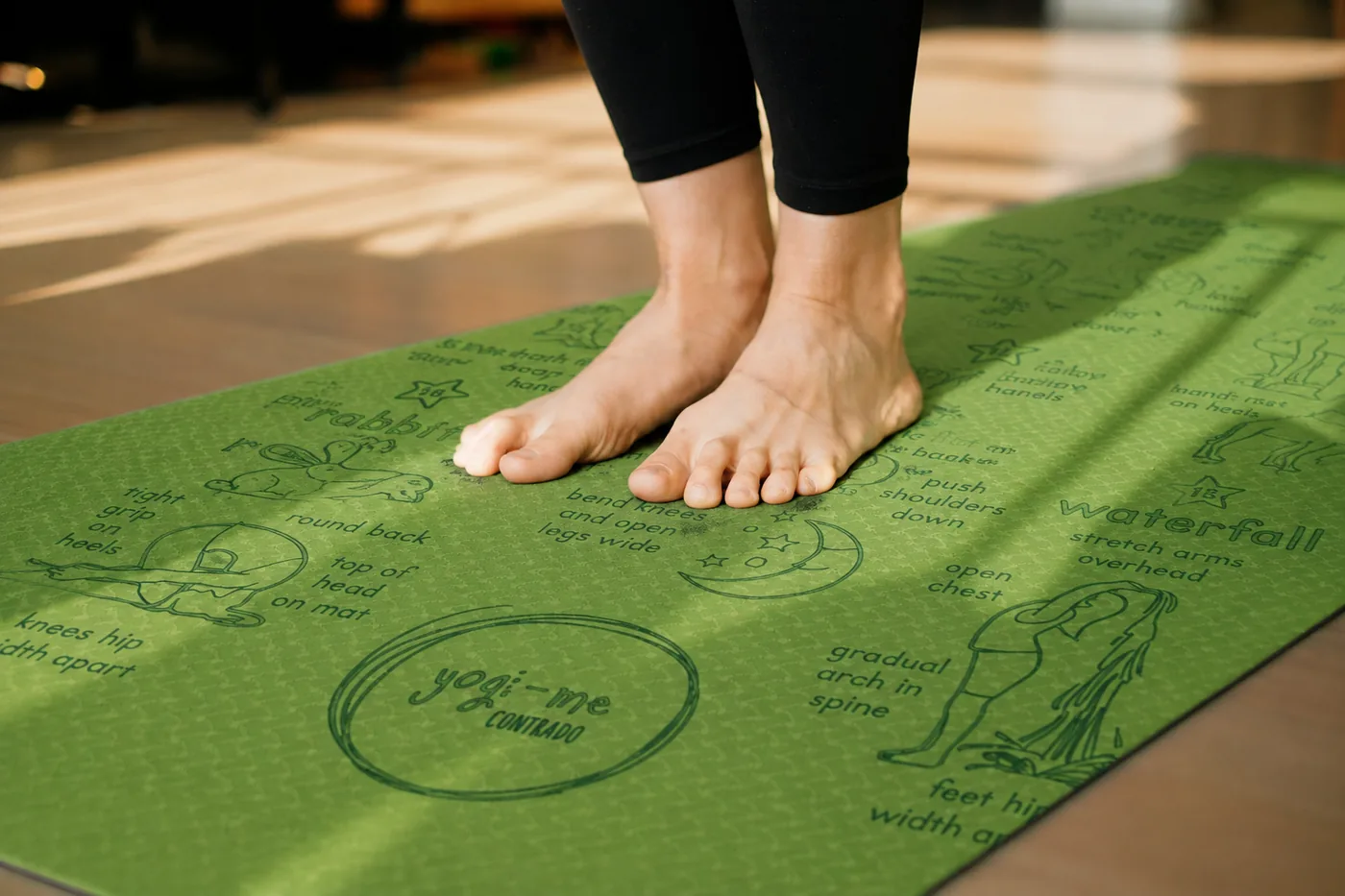
Mindfulness truly needs nothing to start, and we would rather you tried belly breathing tonight than waited for the perfect setup. When your child is ready for animal poses and bedtime body-scans, a cushioned, non-toxic mat makes the floor a friendlier place to be. Our Yogi-Me yoga mat turns quiet time into a small adventure, and you can see the whole range in the Yogi-Me shop. Screen-free, playful, and made for little bodies.
Sources
- Anna Freud: Mindfulness
- Anna Freud: Relaxation techniques
- YoungMinds: Anxiety (parents guide)
- NHS: Physical activity guidelines for children and young people
- NHS: Physical activity guidelines for children under 5
- The Sleep Charity: Children's sleep
- GOV.UK: New screen time guidance for parents of under-5s
- WHO: Guidelines on physical activity, sedentary behaviour and sleep for children under 5